Dinosaurs were in the Ark
Why?
Genesis 6:19 And of
every living thing of all flesh, two of every sort shalt thou bring into the ark, to keep them alive with thee; they shall be male and female.
After the floods, men and these beasts co-existed together - as seen in the artifacts below from ancient civilizations coming from all around the globe.
From
http://www.genesispark.c...rical/ancient/dinosaur/
Note: Evolution teaches that dinosaurs existed and went extinct millions of years before humans, and that humans and dinosaurs never co-existed.
Deep in the jungles of Cambodia are ornate temples and palaces from the Khmer civilization. One such temple, Ta Prohm abounds with stone statues and reliefs. Almost every square inch of the gray sandstone is covered with ornate, detailed carvings. These depict familiar animals like monkeys, deer, water buffalo, parrots, and lizards. However, one column contains an intricate carving of a stegosaur-like creature. But how could artisans decorating an 800 year old Buddhist temple know what a dinosaur looked like? Western science only began assembling dinosaurs skeletons in the past two centuries. (Pictures are courtesy of Don Patton.)


The ancient Sumatrans produced multiple pieces of art depicting long-tailed, long-necked creatures with a headcrest. Some of these animals resemble hadrosaurs. This particular work (Ethnographical Museum, Budapest) depicts a creature that bears a striking resemblance to a Corythosaurus which is being hunted by these ancient Indonesian peoples. (Bodrogi, Tibor, Art of Indonesia, plate #10, 1973.)
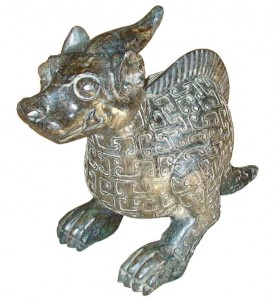
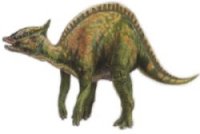
Next we consider a Shang dynasty (B.C. 1766-1122) dragon artifact that was advertised on the Chinese antiquities market as a dinosaur depiction. It displays relief lines in a scale-like pattern, a broad beak, a dermal frill, and a headcrest that is strikingly like the dinosaur Saurolophus (shown on the right). This jade statute, now in the Genesis Park collection, is made of white colored nephrite with differential weathering, cleaving veins and earth penetration, demonstrating authenticity.
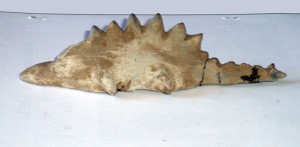
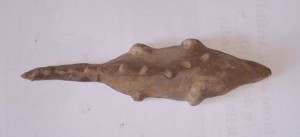
A 1971 landslide in the Girifalco region of southern Italy brought to light hundreds of ancient artifacts of a pre-Greek civilization. A lawyer named Mario Tolone Azzariti asserts that he found some dinosaurian representations among them.
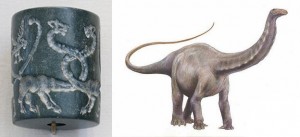
The art below is from the Mesopotamian cylinder seal of Uruk, an artifact currently housed at the Louvre. The animal on the right is an artist’s conception from a skeleton of an Apatosaurus. There are many striking similarities between these two depictions. The legs and feet on the artifact clearly fit the sauropods better than any other type of animal. The biggest difference is at the head. Cartilage forming the shape of a frill or ears may be stylized or accurate (since there is no way to know from the skeletons we have today). As for the musculature, the ancient artist draws with stunning realism. One has to ask where the artist got the model to draw so convincingly the trunk of a sauropod?
To the right are displayed slate palettes from Hierakonpolis showing the triumph of King Nar-mer with long necked dragons and an ancient palette depicting a pair of “dinosaur-like” creatures along with numerous clear representations of living animals (taken from p. 93 of Pritchard’s book The Ancient Near East in Pictures).
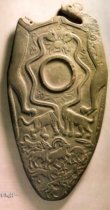
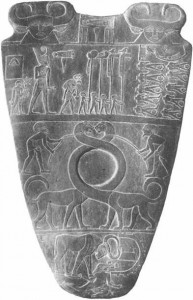
An Egyptian apotropaic wand (or magical “knife”) dating from about 1750 BC displays a similar long-necked creature. Made from hippo tusk ivory, this artifact is currently housed in the British Museum. The preponderance of these long-necked depictions in ancient art motivated archaeologists who do not believe men and dinosaurs coexisted to invent a name for this particular creature. It is called a “serpopard,” supposedly a mosaic of a serpent and a leopard. But for those who believe that man was created in the beginning alongside the great reptiles, these palettes seem to be an attempt to depict a sauropod dinosaur. Note the “Four Dogs Palette” with the “serpopard” cut out for clarity.
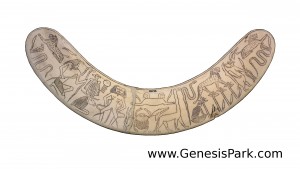
Link to a large image:
http://www.genesispark.c...Museum-Hi-Res-White.jpg


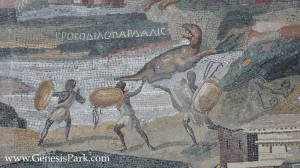
To the left is another beautiful mosaic that was one of the wonders of the second century world. Called the Nile Mosaic of Palestrina, it depicts Nile scenes from Egypt all the way to Ethiopia. Scholars now believe this is the work of Demetrius the Topographer, an artist from Alexandria who came to work in Rome. The top portion of this remarkable piece of art is generally believed to depict African animals being hunted by black-skinned warriors. These Ethiopians are pursuing what appears to be some type of dinosaur. The Greek Letters above the reptilian animal in question are: KROKODILOPARDALIS which is literally translated Crocodile-Leopard. The picture shown here is only a small portion of the massive mosaic. It also contains clear depictions of known animals, including Egyptian crocodiles and hippos. (Finley, The Light of the Past, 1965, p. 93.)
Link to a large image:
http://www.genesispark.c.../palestrina-mosaic1.jpg
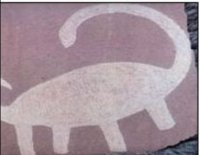
The picture above right was drawn by North American Anasazi Indians that lived in the area that has now become Utah approximately 150 B.C. – 1200 A.D. Even noted anti-creationists agree that it resembles a dinosaur and that the brownish film which has hardened over the picture, along with the pitting and weathering, attests to its age. One evolutionist writes, “There is a petroglyph in Natural Bridges National Monument that bears a startling resemblance to a dinosaur, specifically a Brontosaurus, with a long tail and neck, small head and all.” (Barnes and Pendleton, Canyon Country Prehistoric Indians – Their Culture, Ruins, Artifacts and Rock Art, 1995.) Clearly a native warrior and an Apatosaur-like creature are depicted. Yet another Native American rock pictograph found in Utah (left) seems to depict a sauropod dinosaur.


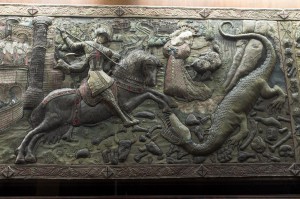
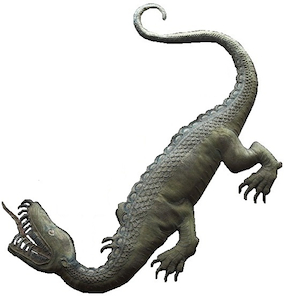
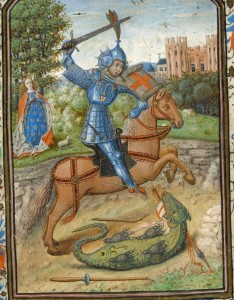
The slaying of a ferocious dragon by St. George is an extremely common motif in medieval art. Various European artists interpreted the dragon differently, depending on local knowledge and lore. A wonderful medieval depiction is seen at the Palau de La Generalitat in Barcelona Spain. St. George’s Chapel contains an altar cloth illustrating St. George’s slaying of a dragon. The depiction bears an amazing likeness to the Nothosaurus, a semi-aquatic reptile (comparison below). Notice the correct-size, the crocodilian body style, and the fascinating long, curved teeth at the front of the jaw that gives way to shorter dentition towards the back.
Large image:
http://www.genesispark.c...s/2011/11/ancient66.jpg
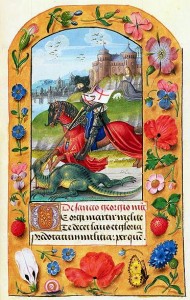
Yet another interpretation of St. George slaying the dragon is found in the Latin Book of Hours c. 1450 AD which is illuminated by the Master of Jean Chevrot and currently housed at the Morgan Library & Museum (right). Notice the Master’s attention to detail, as seen in George’s armor, the birds in the sky, and the dragon’s genitals. The Fitzwilliam Museum contains another portrayal (left) of St. George destroying the dragon (probably by Bruges) from a Latin Book of Hours c. 1490 AD. This colorful work from the Flemish School portrays a remarkably dinosaur-like dragon.
Large image:
http://www.genesispark.c...Hours-Morgan-Museum.jpg
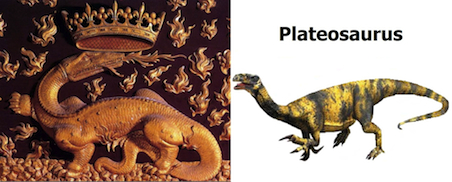
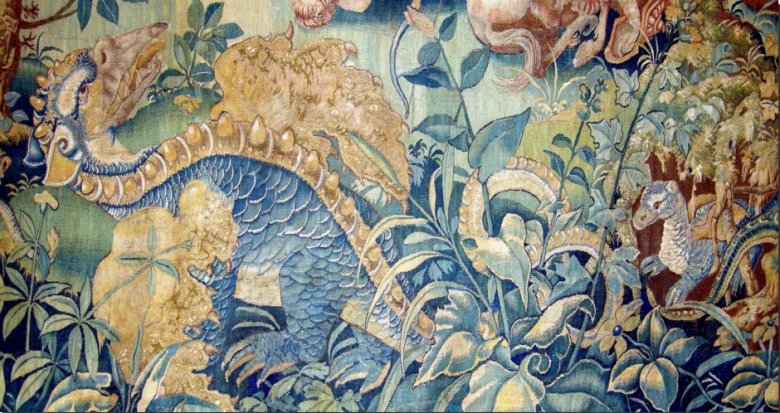
Some of the beautiful French chateaus built at the close of the Middle Ages and early 1500's have dramatic dragon illustrations carved into their walls, ceilings, and furniture. These include Château de Chambord, Château de Blois, and Château Azay-le-Rideau. Note the similarities in the dinosaurian-like dragons and their resemblance to dinosaurs like Plateosaurus and Thecodontosaurus. A tapestry at Château de Blois portrays a dragon (and its baby) with gnarly horns on its head that are reminiscent of the dinosaur Dracorex hogwartsia. Pictures courtesy of Don Patton and Vance Nelson.

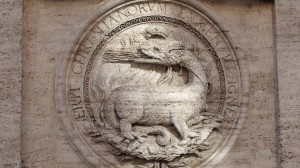
In Rome there is similar artwork on the outside at the Church of St. Louis of the French. This served as the national church of France in Rome and was completed in the 1580’s. Notice on the dragon artwork to the right neck frill, scales, and especially the dinosaurian-looking legs.

In 1496 the Bishop of Carlisle, Richard Bell, was buried in Carlisle Cathedral in the U.K. The tomb is inlaid with brass, with various animals engraved upon it (see right). Although worn by the countless feet that walked over it since the Middle Ages, a particular depiction is unmistakable in its similarity to a dinosaur. Amongst the birds, dog, eel, etc. this clear representation of two long-necked creatures should be considered evidence that man and dinosaurs co-existed.
Before the floods, everything used to be giants:


Why don't we have giants today?
When the floods took place, a lot more happened than the death of life-forms.
On the second day of creation, it is written that the firmament (sky, atmosphere, space) was created.
Genesis
1:6 And God said,
Let there be a firmament in the midst of the waters, and let it divide the waters from the waters.
1:7
And God made the firmament, and divided the waters which were under the firmament from the waters which were above the firmament: and it was so.
1:8 And God called the firmament Heaven. And the evening and the morning were the second day.
The rest of the creation days resulted with a perfect Earth, along with it's inhabitants, but the focus here is on the second day. During the second day, notice that there was water above, which was divided from the waters below. The firmament being that which divided the water above from the water below.
To show that the firmament is the sky / atmosphere, on the fifth day, amongst other things that were created, the birds were created to fill the firmament.
Genesis
1:20 And God said, Let the waters bring forth abundantly the moving creature that hath life, and fowl
that may fly above the earth in the open firmament of heaven.
It is believed that the reason why life-forms were giants during the antediluvian world, was because the environment was conducive for life.
- There was plenty of food (vegetation in an Edenic world).
- The water above the firmament protected life-form's from the suns harmful infra-red and ultra-violet radiation.
- The water above caused the Earth to have a high atmospheric pressure - relative to what we have today.
- The water above ensured that the climate was temperate and perfect to support life-forms globally.
When the floods took place, as quoted Earlier, "the same day were all the fountains of the great deep broken up" & "
the windows of heaven were opened" - The layer of water that was above the Earth, above the atmosphere - collapsed. The water being used as one of the two sources for the flood waters.
Today, it rains from above, but the water that used to be above, that protected the Earth then, does not exist today.
Because the layer of water does not exist anymore:
- Earth's life-forms are exposed to the sun's harmful IR & UV radiation - thus destroying and shortening life and causing things such as skin cancer & wrinkles.
- The Earth's atmospheric pressure is significantly lower, causing living organisms to NOT grow to their ideal sizes.
- The Earth no longer enjoyed the guaranteed temperate climates that was conducive for life, instead, the Earth began experiencing extremes in climatic variations - thus causing food & water shortage.
Genesis 6:3 And the LORD said, My spirit shall not always strive with man, for that he also is flesh: yet his days shall be an hundred and twenty years.
Prior to the time of the floods, humans lived to 900+ years, but because man was wicked, his life was shortened to 120 years. If the current world is as it is because of wicked men, how much worse would it have been if God allowed men to live for 900+ years? All the wars, garbage, destruction, pollution etc...
It is commonly taught that the method that God employed to shorten man's lifespan was to allow man to eat meat. This is because, after the flood, all the vegetation was destroyed, the only thing that could be eaten was meat, and that is the reason why God commanded Noah to take the clean beasts by seven's and take the unclean beasts in pairs - the extra clean beasts were for food.
Genesis 7:2 Of every clean beast thou shalt take to thee by sevens, the male and his female: and of beasts that are not clean by two, the male and his female.
It is true that the introduction of meat in the human diet played a role in shortening the life-span of man, but the other factors that were involved which are often not mentioned, are those that have been mentioned earlier, regarding changes in the Earth's environment and climate.

Dinosaurs do not exist today because they went extinct.
Why did they go extinct?
- The post-flood Earth was not conducive to support dinosaur life, while before the flood, Earth was Edenic.
- For such immense animals to breath well while having small nostrils, an environment with more atmospheric pressure would be required, or else the cells would not get sufficient oxygen saturation.

- Large amounts of food / vegetation would be required (after the flood, vegetables were so scarce that man had to eat meat - this is besides the need to shorten man's life).
- The sun began to destroy the environment, shortening life, speeding up aging, causing desserts (shortage of pro life environments) and causing harmful radiation.
- Shorter life-span means shorter adulthood - with the same gestation period, meaning fewer reproduction cycles, while each each generation's life-span shortens as time progresses.
- Extremes began occurring (extreme climates), the Earth began to have polar ice caps.
- The upper Northern hemisphere and the lower Southern hemisphere were too cold for habitation or for vegetation to grow.
- Other parts of the Earth were too hot - Desserts, and food & water scarcity.
- Earth (about 70%) was underwater - Meaning that there was less good land and it would be difficult to migrate to other regions of the earth.
- There was high competition for whatever resources were available.
- They were hunted by both men and predators.
And other reasons ...
Leading to the extinction of dinosaurs and other plant and animal species.
Much of the original bio-diversity has been lost, in both the plant and animal kingdom.
Seeds, grains, nuts, fruits, vegetables and animal diversity that we have today are only a fraction of what existed originally.
If the current proportions of life-span and life-size for both the plant and animal kingdom is up to, or less than a tenth (1/10), in comparison to the antediluvian world, why can't we also believe that it could also be so with with bio-diversity? - The dinosaurs being part of what has been lost.
C&P
Robert Berner of Yale and Gary Landis of the U.S. Geological Survey analyzed air bubbles that are believed to have been trapped in amber some 80 million years ago (Biblically, the Earth is about 6000 years old).

"The researchers clamped the amber into a vacuum chamber of a quadruple mass spectrometer, a device that identifies the chemical composition of a substance. As the machine slowly crushed the sample, the microscopic bubbles were released, exhaling up to 100 billion molecules. These breaths disclosed some surprising evidence: the ancient air contained 50 percent more oxygen than the air today." (Discover, February, 1988, p. 12. A Yale study published in the March 3, 2000 issue of Science independently confirms the high levels of oxygen present in the earth’s distant past.
http://english.sdaglobal.org/research/dating.htm
C&P
http://www.discourseandd...om/frontPage/tomato.htm
Japanese physicist Dr. Kei Mori exposed plant life to two of the conditions of the original world ecology -- before the Great Flood.
He grew tomato plants under a plastic dome which filtered the ultraviolet rays; and he increased the carbon dioxide. After two years, a cherry tomato plant was 16 feet tall, with 903 tomatoes on it. After six years, the same tomato plant was over 30 feet tall and had produced more than 5,000 tomatoes.
That tomato plant just didn't want to die. Ask yourself now, How long do tomato plants usually live? Perhaps five or six months? They die of old age, destroyed by ultra-violet radiation.
Could this have some bearing on how old people would have lived under the same environment?
Greater Air Pressure ThenThe atmospheric pressure, as well as the oxygen content, had to be greater in the past, in order to support the huge life forms which then existed.
My friend Dr. Carl Baugh, of Glen Rose Texas, has set out to build the world's first hyperbaric biosphere, 62 feet long. Its purpose is to simulate the context of our original world. An engineer from NASA has called it the greatest experiment in history, ever performed in the name of science.
Research indicates that essentially everything was larger in the past. For instance, the club mosses which today reach 16 to 18 inches often approach 200 feet in the fossil record.
The difference may well be in the atmospheric pressure. In today's atmosphere we have 14.7 pounds atmospheric pressure per inch at sea level. But to oxygenate the deep cell tissue of those great dinosaurs we need much greater atmospheric pressure.
Research has shown that when you approach two times today's atmospheric pressure, the entire blood plasma is saturated with oxygen.
Imagine having the energy to run 200 miles non-stop. Such atmospheric pressure would also promote rapid healing!
A Canopy Would Promote Such Atmospheric PressureIt is believed that before the Flood, a water canopy enveloped the earth, above the atmosphere. With such a canopy, the atmosphere would be pressurised to a greater degree than we have now.
There is surprising evidence. 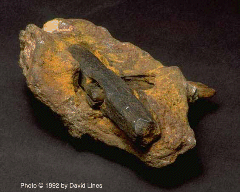
In the 1980s, a pre-flood hammer, found inside a rock stratum, was analysed by the Batelle Laboratories in Columbus, Ohio -- the same laboratory that analysed moonstones. The elemental analysis showed it to be 96.6 percent iron, 0.74 percent sulphur, and 2.6 percent chlorine.
Physicists tell us that under today's atmospheric conditions you cannot compound chlorine with metallic iron. Yet here it is. Today, chlorine can be joined with iron as solid metal only in two atmospheres of oxygen pressure, and only in the absence of ultraviolet radiation.
Of course, ultraviolet radiation would have been filtered out by the protective canopy.
Research indications are that the pre-Flood atmosphere is the only plausible explanation for the forging of this metallic artifact.
We are living on degenerated and in a degenerating Earth
Isaiah 51:6 ... and the earth shall wax old like a garment ...
Despite the barren landscapes and the lost plant and animal species, we can still find beauty in a world that has gone through a total catastrophe. The imagination is left to struggle to fathom how Earth must have been before the floods, or even, before sin entered the world (before the fall), nonetheless, it has been promised that the Earth will be restored to even greater glory than it had before. None need not be there. It's free, simply accept, believe and be faithful till the end!
Psalms 37:11 But the meek shall inherit the earth; and shall delight themselves in the abundance of peace.
The same promise was reiterated in the NT by Jesus in the beatitudes.
Matthew 5:5 Blessed are the meek: for they shall inherit the earth.
Heaven will be paradise on the Earth re-created. Heaven is not the depicted lie about a distasteful place, floating on clouds.
New earth
Isaiah 65:17 For, behold, I create new heavens and a new earth: and the former shall not be remembered, nor come into mind.
Revelation 21:1 And I saw a new heaven and a new earth: for the first heaven and the first earth were passed away
They tried to bury us, they didn't know we were seeds.