Rank: Member Joined: 5/15/2019 Posts: 694 Location: planet earth
|
Wukan will not be happy at ALL with this news. Now if posh Kili has gone this way, what about kiri, Grogon, wukan's first (and only) love  . Quote:How Kilimani lost its allure to become Nairobi's gang, illicit sex capitalWednesday, August 26, 2020 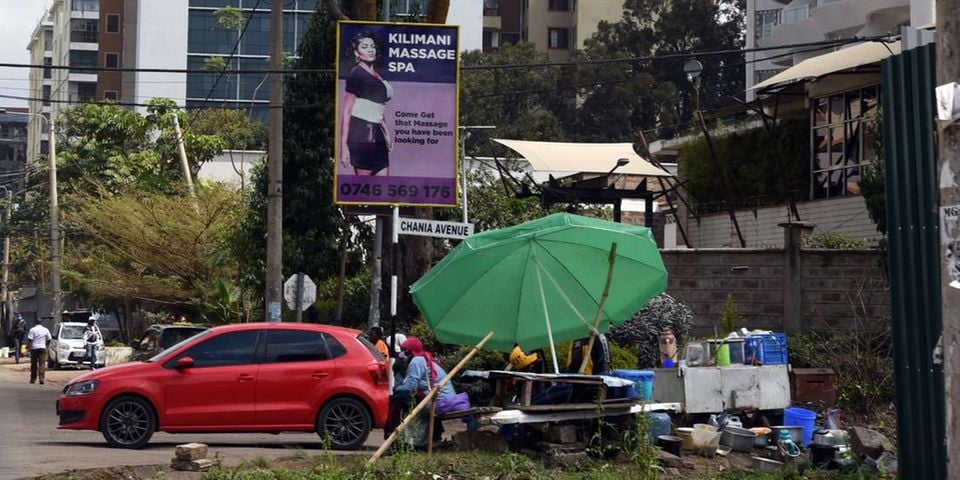 A bilboard advertising a massage spa is seen along Lenana Road in Kilimani, Nairobi on August 25, 2020. Such billboards have become a common sight around the neighbourhood. A bilboard advertising a massage spa is seen along Lenana Road in Kilimani, Nairobi on August 25, 2020. Such billboards have become a common sight around the neighbourhood. Evans Habil | Nation Media Group By Vincent Achuka Reporter Nation Media Group What you need to know: Kilimani is an interesting, eventful neighbourhood. Lately, it's become associated with all manner of white collar crime and illicit sex, but it wasn't always like this. A poster advertising massage services at the intersection between Gitanga Road, where Lavington ends, and Ole Odume Road where Kilimani begins, shows just how low the upper middle class estate has sunk over years. At face value, the poster -- and there are many of those dotting roads, public clocks and apartment walls in Kilimani -- gives the impression of booming demand for massage services or cut-throat competition among providers. The reality, however, is that the word 'massage' is a euphemism for something else -- sex work. And you don’t have to go too far to establish this. Just dial the numbers provided or visit the online pages advertised on the posters and you will stumble on what could be Nairobi’s most thriving underground prostitution industry. Curious children A Kilimani resident, Mwihaki Muraguri, at one point caused an uproar on social media when in a series of tweets, she confronted authorities demanding to know whether they were aware of the booming sex work industry in the area. This is after her children asked her while on their way to school what a massage meant.“Last week on my daily route, four signs went up on this roundabout advertising a ‘spa’. My nine-year-old son asked me ‘what’s a massage spa?’ Every day he and the 300 primary kids who walk this route must contend with this,” said Mwihaki. “We both know they are not a conventional spa but cater to adults seeking joy. Given that every public advertisement in my city is licenced by the Nairobi County Government, why are we allowing our children a daily visual assault of services that have nothing to do with them?” she posed....... read more here: https://www.nation.co.ke...cit-sex-capital-1926028
imagine raising your kids in Kili. And WUkan has the nerve to come somea us on the DC thread ati we do not have sewer lines or public schools Quote:
That prostitution is rife in Nairobi has never been in doubt. In fact, sex work has thrived in Nairobi since time immemorial, earning roads like Koinange Street the dubious distinction of being a one-stop shop for sex.
What worries many Nairobi residents, however, is the growing trend of twilight girls moving away from streets, night clubs, bars and lodges into the estates.
And in Kilimani, many standalone houses and apartments have been converted to brothels.
“It is not that these things are happening in secret. Everyone, including the police, know about the prostitution taking place here but they look the other way,” Kevin Opala, a resident, laments.
“I pity the children who are being brought up here,” he adds.
Modern-day slavery?
Unknown to these residents and perhaps even the police is that along with the booming underground sex trade industry in Kilimani, modern-day slavery is thriving in tandem with the prostitution.
The shadowy players, faced by cutthroat competition amongst themselves, force the girls they employ at these brothels to not only work long hours but also prohibit them from leaving the premises at all.
Once signed up to the trade, as the Nation found out, the identity cards of the girls are swiftly confiscated.
They are then cramped in one of the bedrooms where they live for as long as they are working. They are only allowed one day off per month. Any time they leave the premises is presumed to be an outcall and a demand for money made will be made by the owner of the brothel.
“I will have to pay the boss Sh10,000 if I leave here unless it’s my off day,” a masseuse in one of the spas told this writer.
Prostitution remains outlawed in Kenya. The Penal Code, however, also makes it illegal to profit from the sex work of others, and to aid, abet, compel or incite prostitution. This includes operating brothels.
But if you thought that the booming underground sex trade being carried out in plain sight of young children in Kilimani is its biggest problem, then you have barely scratched the surface.
Gangland
In the last two years, the estate bounded by Valley Road to the east, Denis Pritt Road to the north, Ngong Road to the south, and Korosho Road to the west has earned itself an unenviable title of being Nairobi’s gangland capital.
Today, barely two months will pass before a macabre murder or bizarre incident is reported in Kilimani. On Thursday, the Directorate of Criminal Investigations (DCI) is expected to return to court and explain if it has found out who killed Sheila Murage last month within the area.
Ms Murage's body was discovered last month in a flower bed at Santonia Court after an overnight party with her friends on July 17.
Santonia Court on Kirichwa lane, Kilimani on July 22, 2020.
Milimani Chief Magistrate Martha Mutuku released the three suspects linked to her death on a Sh100,000 bond or Sh50,000 cash bail each.
An autopsy report indicated that she suffered head injuries inflicted by a blunt object and was sexually assaulted before she was killed. The body also had physical injuries on the back and blood was oozing from her nose when she was found. There were also bruises around her wrist and her clothes were torn.
“The court directs the suspects to report to the Kilimani Directorate of Criminal Investigations (DCI) every Monday until August 28, when the case will be mentioned for further directions to be given,” Chief Magistrate Mutuku.
How it changed
Kilimani wasn't always like this though. Once among the city's posher suburbs with exclusive low-density residentials loved by senior civil servants, the middle class and the rich, the neighbourhood's deterioration can be traced to one major event.
Changes began in 2016 when the Nairobi County Assembly passed a motion allowing the construction of commercial centres and high rise apartments in upmarket neighbourhoods.
Under the new law, affected were areas classified under Zones 4, which comprises Spring Valley, Riverside Drive, Kileleshwa, Kilimani, Thompson and Woodley.
What followed was a rush to bring down the remaining 1950s bungalows to make way for modern multi-storey apartments and office blocks.
Flee Nairobi core for DC before it is too late, buddies! 6 years on..the second and only other Wazua Billionaire!! Mungu ni nguvu yetu🙏🏾🇰🇪🔥🔥!
|